i am pretty sleep deprived after a night of last minute packing and precious time with family. but i am not sure why i feel a very strong urge to write right now, and it is probably because i might not have the same juice after a nap.
it is my last day in malaysia. i will be flying to the uk in about 12 hours. i cannot believe that this is actually happening. now that it is, i am incredibly excited and finding it hard to contain. at first, i dreaded leaving as i reveled in a serious case of impostor syndrome. yes, you can imagine the past 2.5 months were not the most fun. the long episode of depression, anxiety and heartbreak, even as surprisingly manageable as they were, truly did wore me out.
i couldn’t help but to wonder if i was really deserving or capable of fully embracing this opportunity. i couldn’t help but to feel somewhat alienated by this opportunity. i wondered – do i sincerely believe that going to cambridge sets me apart from my peers? am i just another privileged middle-class malaysian who had the right connections to secure this deal? do my research interests reflect a genuine effort to shed a historical light on conflict in southeast asia? am i just as bad as any helicopter white male who thinks that they can just waltz in and document the social histories of marginalized communities? i could drive myself insane with these doubts, and i had no idea why i couldn’t stop them. after taking active measures to calm myself down and make an introspection, i underestimated how being vulnerable to the wrong people at the wrong time could actually leave you with internalized narratives of self-deprecation. perhaps they didn’t know what they were doing. but i wouldn’t put it pass them to be able to get into my head in such a poisonous way since they have done it before. well, it’s alright. i have learnt, and i am healing.
nonetheless, it was really a relief to be surrounded with my best friends and those who have been very supportive and encouraging of my journey in academia. it was best for me to have expressed these vulnerabilities to those who were kind and reassuring. dinners with a un economist / malaysian ex-avenger can get pretty overwhelming, but i guess i was kinda happy to know that i wouldn’t be struggling alone in kampung cambridge (please know that i use that term sarcastically hehe). moreover, as much as he might think learning thai is not practical, historians of transnationalism would tend to disagree with notions of utilitarianism in language learning, as they each offer a gateway to understanding cross-cultural phenomenons. which is why i have decided to put off learning thai until i have a firm decision on whether i am pursuing this topic at the phd level. so, i will spending the next 9 months learning basic arabic! a choice i had to make over persian, if i was going to be a bit more strategic about language training at the mphil level.
i also signed up for a graduate workshop titled “histories of race”, organized by the faculty of history. i was immediately attracted to it when i read that the intention of the workshop is to disrupt the “national” by exploring the impact of race ad the construction of race and racial hierarchies across geographical and chronological boundaries. it also hopes to breakdown boundaries between the theoretical and the empirical; the transnational, national and the local, and comparative approaches and case studies. yes, all these things really do resonate with what sumit has thought me in the past 3 years. inevitably, it has shaped my scholarly trajectory and i have become very comfortable at what it is able to offer. at the moment, it comes off as a little intimidating to share progress of my dissertation topic every fortnight in the course of 9 months, but i hope that the feeling would wear off and i would be more determined and focused to complete my dissertation well.
speaking of which, i think i only really starting feeling some type of way after seeing sumit one last time. accompanied by petra, a fellow minion who is being supervised to write her doctorate thesis on the subaltern histories of kuala lumpur, we adjourned from semenyih to an indian restaurant called “lotus” at jalan gasing, which he described as an institution. one cannot dispute such a comment once they have visited it. more often than not, the place really does reflect on the state of new malaysia as well – worn out, tired and desperately clutching onto the relics of the previous regime’s past. and it was here that we spent long hours reflecting on my impostor syndrome and how it was birthed from a persisting mystic surrounding cambridge as not just an educational institution, but a political one too. i guess all that matters is that i find ways to remain grounded, and actively commit to the spirit of academic integrity that got me here in the first place. i look forward to meeting and mingling with historians, young and old, and most definitely, those that sumit rests much confidence in (that being tim harper omigosh). something really important to point out, that people like amartya sen, ha-joon chang and priyamvada gopal are rendered as normal in a space like cambridge. it is only when we are outside that we often make them out to be a lot less accessible and approachable. not sure if the same could be said about the late stephen hawking though.
as the days go by, different elements about my life is cambridge are gradually being demystified. what a relief honestly. and i am beginning to feel myself again, and have the inner power to take ownership of such a beautiful experience. parting ways, i have received gifts from friends and family that are equally as beautiful, from journals to pens, clothes but the most unexpected yet poignant ought to be the ganesha statue from sumit. “i was trying to find a bronze or silver one, since it looked a little more classy but i guess this will do”, he said as he handed me this colourful, commodified artifact sealed with a tacky misspelled label, “flying collectables”. i was puzzled as i never perceived him as a hindu, whether in the practical or spiritual sense. to which he remarked, “why would you need to believe in hinduism to believe in ganesha? he frees you of all obstacles no matter what, and i hope he does the same for you”.
we parted with tears stinging our eyes, embraced in the warmth of big hugs and words i thought i wouldn’t hear from him, “i will miss you a lot”. but yes, i will miss him too. so very much. my heart sinks at the thought of this phase in my life being sealed with love, but it is very, very full right now. and now we go on to this great, uncertain road. not sure where it is going to take me, but i am ready for whatever life throws at me. i guess every time i think i am on the brink of failing my mphil, i can look up and see the elephant god watching upon me, and an extension of the man i consider to be like a father, hovering and reassuring me that he will move these hurdles away. no better way to put it than how petra did over text:
maybe he was an elephant in another life. beast of burden for mischiefmakers to carry us to school.
it’s been quite a long time since i last wrote here. i’ve been quite busy trying to finish my undergraduate dissertation which was due on 24 may. at first, i thought i was not going to meet the extended deadline because every time i looked at the word doc, i was overwhelmed by the sense of shame that came with leaving this project to the final countdown. but then this kiasu-ass fire lit up inside me and i was like…. “dei netusha… whatever it is you die die must do finish on time no need waste the time – after this can sleep lor”. and that was it. game on!
i had at least 10 days to write up the remaining 6000 words, alongside reading up about hugh clifford for the final chapter. it was terribly intense especially since i was even hit with a terrible flu (of which i am still trying to recover from because of a relapse lol and it is starting to feel like a lung infection). the good thing was that i had the motivation and loving support of my mom and partner to persist with writing. ultimately, i ended up with a decent piece. in my heart i knew that i could write a much better thesis than this, but i decided that i cannot be continuously punishing myself for the horrible circumstances i have been in for the past year. it has been very challenging to undertake a rather original research project, while coping with negativity in my surroundings, work commitments, as well as recurring endo flare-ups (including lumps in both my tits… haiyo). i think i deserve that pat on the back for carrying the burden of this situation while writing papers that got stellar critiques.
i wouldn’t be able to imagine this at that point in time. but now that i am looking back, i am like “ok la, i am really too hard on myself”. it is okay to falter, stumble and potentially fall flat on my face. i am not one to cope with failure well. in fact, even if the incident was completely out of my control, i tend to perceive it as a personal failure. when i could not secure a scholarship for my final year, i saw it as a failure on my part. i felt i didn’t get grades that were good enough, i was a bad daughter for not withstanding the financial and emotional abuse of my father so that i had security, and that i was simply unworthy of any form of protection. it did not help that a potential funder mocked my estranged relationship with my father. it hurt my feelings a lot, but then i realized that he is an archaic, colonial male that would be too shallow to understand the complex lives of coloured women like me. then i totally bounced back from it. it helped that my mother stepped in as well and removed me from the equation.
the rockiness of my relationship with my partner continues to be seen as my personal failure. this is because i see myself as someone ill and constantly in need of a care-giver. in some situations, partners are able to take on that role due to their strong health. but in reality, this is not at all experienced by many couples of my generation. i am learning to take several steps back and find healthier ways to cope with my situation. it helps that i do not talk to A LOT OF PEOPLE anymore. i am bamboozled by how many idiots i have let into my life (although my partner would probably think this is a judgmental remark to make but tbh i really couldn’t be bothered at this point after how much drama most of them have brewed in my life). however, there is a sense of loneliness that plagues me because i do not trust most people in my surroundings anymore. i am slowly trying to check in and build relationships that are solid. for the time being it seems to be working out well. i guess it is also helping ease pressure of me and my partner. the prospect of long-distance is also crippling, but i guess we will be ironing these details out in the near future.
apparently i got the scholarship to cambridge. they’ve just been procrastinating on sending the letters out due to some bureaucratic shenanigans. it doesn’t feel real just yet, so i haven’t been able to process it. although, i really do need to get to fulfilling my conditions especially resitting my goddamn ielts exams. yikes. i will most likely be going out in the first week of september. i will be following my sister to andalusia for her dressage training programme. i can’t wait… i have never been to europe. and after that, we will be heading to cambridge to help me get settled in my new place. i opted for russell street instead of the meadows because i am not really a fan of sharing bathrooms hahhahaha. the russell street rooms are also for graduate students only, which means i can avoid undergraduates… yipee.
another great thing to happen is that my flare ups have been dormant for a while. it is most likely because of this medication i am on called visanne. i am still annoyed at my previous gynae for deliberately avoiding me from a more cost-effective, and no side-effects solution like visanne. it would take time to shed off the damage lucrine depot has done to my body, but i feel pretty great the past month. the best thing to happen was losing 5 kgs of body weight!!!! i feel and look great, especially after my partner treated a day at the salon to get my hair coloured!
coffee with my sister after my post-submission birthday treat at the malaysian philharmonic orchestra. ugh, i love that guy uwu.
anyway, i still have two writing projects to work on until mid-june… the first is the delayed book project with farish noor ahahah… glad to say that it’s not my fault but also feel bad about the burn out. i will need to edit my thesis to meet the format requirements plus an additional 3000 words. sounds daunting but when i wrote my chapter on clifford, i instantly knew that there is so much more to include. i didn’t get to indulge further in the ‘lazy native’ tropes and how he is proof that colonial discourse is ambivalent and hybrid, as bhabha describes. i was deeply fascinated by clifford’s conflictual expressions in his writing. clifford’s life as a young british man who had a class-informed racism towards malays just opens up an avenue to critique present understandings of colonial discourse in british malaya. i hope that my contribution to the study of malaysian history through the critical study of the pahang civil war truly makes a difference.
but i wouldn’t know that would i?
i was also invited to write a 2000 word op-ed for a singaporean anthology called budi kritik. it is quite an honour to be asked to write off lately. i was not confident about the quality of my writing for some years now, and the recent developments have really been confidence-boosters. i look forward to my eventual recovery so that i can work on these two projects.
i guess i am delighted to have checked in with myself and let you and myself know that i am doing just fine. i don’t have reasons to be sad for the time being and maybe perhaps, a lot of things are simply not worth being sad about anymore.
i cannot tell you who wrote this to me. but i am so glad i had someone tell me this sometime ago. i need to revisit more often. now that i am in a very difficult time of my life. i am also nearing the end of my studies. i have about 10 days to write the rest of my dissertation up.
wish me luck.
I understand. It seems to me that you are facing the prospect of burn-out, which is a common malady among scholars the world over. But in all such cases, including my own, re-building borders and boundaries seems the best practical way out of the mess.
I had to deal with a useless father as well, but the fact is that there was never any closure between me and him until he died, so it took me some time to realise that i had to live with the fact that there would be no conclusive end to that narrative.
When you say that you feel the same as the ‘fragile Netusha from 4 years ago’, that is the key to your predicament- You are stuck in that past and you need to draw a boundary between the past and the present. We all deal and react to depression differently and some of us choose to ruminate and mull over things past again and again, in search of some narrative that can give a meaning to it all.
That is not going to happen, and you need to accept that. You going back to that past will only conjure it up again, like some demon , and it will return to haunt you in the present. There is no need to do this, but it also means that you need to seriously ask yourself why you are and have been torturing yourself- do you hate yourself, or feel you dont deserve happiness?
These are questions that you have to ask and your answers need to be clear and short and only then can there be some clarity.
At present though your ship seems to be leaking all over, so the main thing to do – in practical terms – is to plug the biggest leak, and that seems to be the absence of a boundary between past and present. You have to root yourself in the here and now- The Netusha of 4 years ago is no longer here, so why do you bring her back? She’s back there somewhere, doing her own things, so leave her be. To know how far you have come, and how far away that past Netusha is, think of how far you have gone and how great the distance is between you (now in the present) and she (back in the past) is. You are now in academia, you are working well, you are going to contribute a chapter to our book, you will get published. These are things you need to take account of now, in the here-and-now.
Every society has notions of ghosts and spectres, of haunting and possession- These are just narratives about memory and the past coming back into the present. Draw the line and tell the Netusha of 4 years ago that you have moved on, and if she wishes to follow you then it has to be on your (present) terms, and not her terms from the past.
Boundaries are important, as is being rooted and focused.
i’ve feeling very low lately until i recalled this essay i wrote for a book that never materialized. it was supposed to be reflections of malaysian experiences in iran for the first time. i wrote something really personal and raw to me. when i look back at it, i am reminded of a kind of vibe that i cannot relate today. it is indeed strange. have i grown that much? or am i just out of touch with my own feelings?
either way, this piece will never see the light of day in print form. but i guess it is worth being put here to serve as a reminder of my journey towards healing. persian poetry has played a major role in my mental health from the philosophical perspective. now that i have pieced that together (or somewhat i think), i am now onto the second aspect, which is the medical recovery. anyway, if you are reading this and feeling low, i just want you to know that spiritual self-connection is essential to coping with depression. yes, it is a medical problem but from my experience, it can be a very overwhelming philosophical burden too. this is because it engages with the purpose of existence, the will for optimism and the vitality that resides within intimacy. here’s a spectre of my depression’s past.
From Khayyam to Hafez and the Healing of a Broken Heart
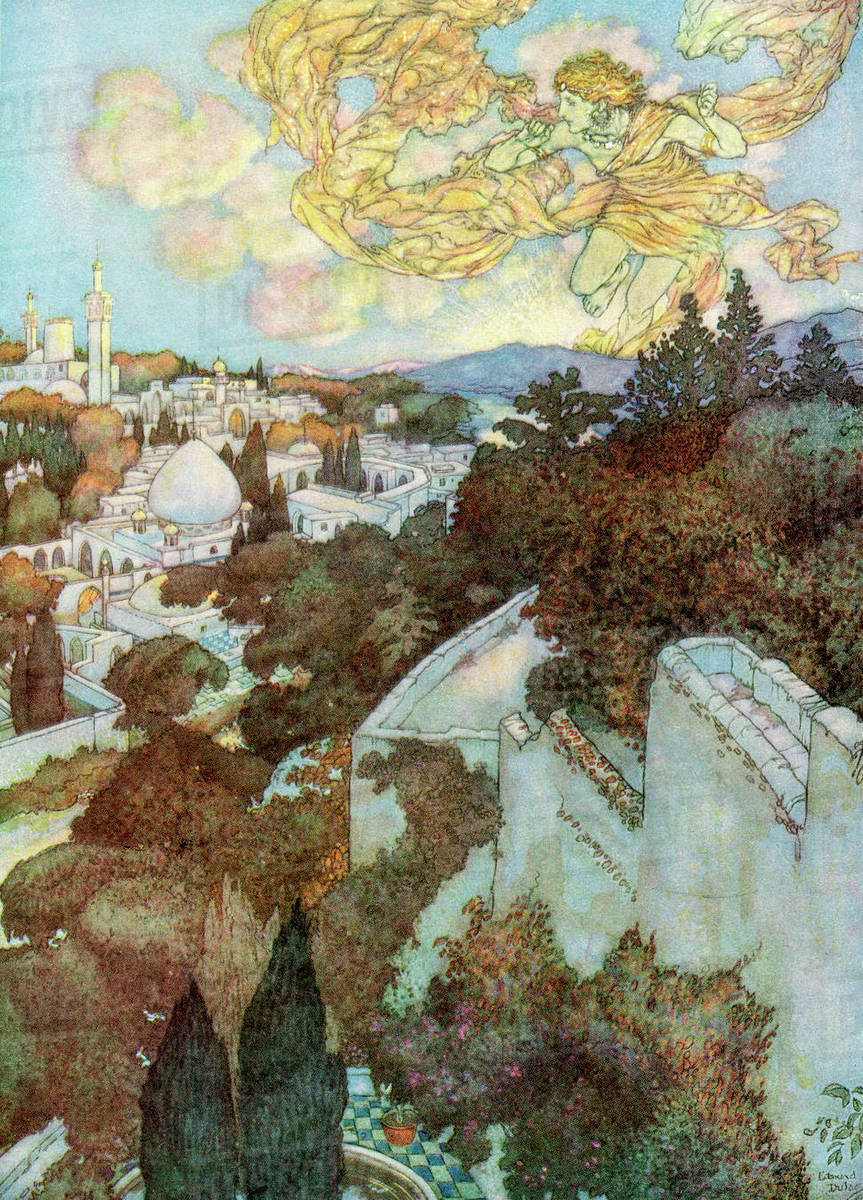
One of my most favourite paintings are by the early 20th century book illustrator, Edmund Dulac. These are from his interpretations of the Rubaiyyat of Omar Khayyam.
Introduction
“As far as you can avoid it, do not give grief to anyone. Never inflict your rage on another. If you hope for eternal rest, feel the pain yourself; but don’t hurt others”.
The Rubaiyat of Omar Khayyam
Every time I think of this quote, I am reminded that it is often difficult to actually avoid inflicting grief upon others. After all, aren’t human beings so fragile and vulnerable to the contingent tide that we have immersed ourselves in? Every time I think of this quote, I am reminded that eternal rest may not be the destiny for all us as long as we are restless souls. After all, aren’t human beings so fragile and vulnerable to the point we succumb to wherever the currents of our grievances may take us?
Such were the thoughts of a 16 year old girl in the suburbs of Seremban. She was often tired, sullen and pessimistic about the future as the voices in her mind and around her say, “This isn’t good enough”, “Geez, you screw up everything” and “You’re such a freak of nature”.
There’s more from where that came from, and it would be the book of verse she held in her hand that could give her the kind of solace that nothing else could. It was the Rubaiyyat of Omar Khayyam, as translated by Edward Fitzgerald. She would spend her evenings perusing quatrain after quatrain, while imagining herself in the painted universe of Edmund Dulac’s Persia. Some days she walked through a garden of roses, while on other days she sat beneath the moonlight as she rejoiced the love of the divine Beloved, or so she desired. There was a strange, enigmatic energy that came from reading the Rubaiyyat. It was like there was a promise of attaining a peace of mind that she was destined to keep.
My first encounter with Omar Khayyam was somewhat arbitrary. It was an accidental stumble while flipping through the pages of the Reader’s Digest Illustrated Encyclopaedia in the library of my home. I was looking for suggestions of new poetry to read and given that I was exposed to only English literature, I was eager to learn the poetry from different parts of the world and find something that I could connect with beyond the sonnets of Shakespeare. It was at this spontaneous moment that I found myself puzzled by the line,“A Book of Verses underneath the Bough/ A Jug of Wine, a Loaf of Bread – and Thou”. It was indeed puzzling, given that the first thought that arose was, “A wine-drinking Muslim? Impossible in Malaysia”. Perhaps that was what attracted me to Khayyam in the first place – unconventionality and unconformity. He would render the world, the universe as ultimately uncertain and dismiss the arrogance of thinking minds that believed its knowledge to be in the grip of their palms. He wrote;
Why, all the Saints and Sages who discuss’d Of the Two Worlds so wisely – they are thrust Like foolish Prophets forth; their Words of Scorn Are scatter’d, and their Mouths are stopt with Dust.
Myself when young did eagerly frequent Doctor and Saint, and heard a great argument About it and about: but evermore Came out by the same door where in I went.
With them the seed of Wisdom did I sow, And with mine own hand wrought to make it grow; And this was all the Harvest that I reap’d ‘I came like Water, and like Wind I go’.
The Rubaiyat of Omar Khayyam
At first impression, Khayyam’s existentialism might render one to feel hopelessness but for an exhausted young soul, it might be a remedy to dealing with the worldly polemics surrounding oneself. This is because I felt there was some sort of peaceful rest with knowing that I did not know or control everything, and through knowing this, there is acceptance of a certain order of things. However, I am still granted with the agency of mind and body that I possess. My hand will nurture and harvest Wisdom that is mine own. I knew I came like Water, and like the Wind I will go. To Khayyam, Life is a journey from one destination to another, and the accumulation of wisdom is the purpose and antidote to surviving it.
Thus, this would be the ideal that I held on to in the midst of bitterness and alienation. By 17, I suspected that it was clinical depression. It was meant to be kept a secret, at least for a while. Distraction helps keep the lingering sadness at a distance. So does seeking solace in Khayyam’s whimsical, rebellious yet profound poetry. This would serve as the marker of Persian poetry as an essential part in the healing a broken heart.
Marching on, without moving on
In spite of coming from almost halfway across the world, there was something oddly relatable about Persian poetry. No one could explain the reason for this better than Arp and Perrine in their introduction to “Sound and Sense: An Introduction to Poetry”. To them, poetry is inherently universal and ancient. We do not give great importance to poetry only because we derive tremendous pleasure from reading, listening or reciting it. Poetry, in its totality, could be regarded “as something central to existence, something having unique value to the fully realized life, something without which we are spiritually impoverished”. Poetry, for me, had become a necessary sustenance in my mental life. As the world continues to make an assault to my senses, I do think, once in a while, that I have beguiled myself with the pursuit of an intellectual life. So much so, a false consciousness had blanketed me from the occasional weavings of sorrow. Like medicine, reading poetry acted as a remedy to an illness that leaves the patient with the impression that she was healing.
But I was wrong.
By this time at 21 years old, I had delivered two TEDx presentations, moderated several public forums, been a young columnist at a popular news portal and manage my own alternative history project called Imagined Malaysia. Success may have followed me wherever I went, but so did the void, which is my illness within. During this time, the words of Jalal al-Din Rumi, another very popular Persian poet and scholar, would help fill the emptiness. In a way, it felt like Rumi was the wine that poured and overflowed the heart, a very thirsty Cup. His words strung together so beautifully, emboldened with yearnings for love, peace and light. Rumi’s words were the bricks of my imagination – a fantasy of life being a celebration in the sheer mundanity that often consumed my mind. He carried a sense of cherishment, adoration and optimism that would make me so envious. Rumi asked;
“There is a candle in your heart, ready to be kindled. There is a void in your soul, ready to be filled.
You feel it, don’t you?”
Jalāl ad-Dīn Muhammad Rūmī
I replied, “Yes, I do. Very much so”. Later, I found that he asked me again in the midst of frustration, “If you are irritated by every rub, how will your mirror be polished?” Life had brought in greater challenges to cope with, in the forms of finances to family bonds that were close to being severed. How would I, so riddled with the monkey chatters of my distress, ever be able to handle such great irritations in a state of vulnerability? He assured me, “The wound is the place where the Light enters you”. Without a doubt, reading Rumi felt more like a conversation with an enlightened soul as he had the most comforting responses to the most discomforting thoughts plaguing my mind.
It was a constant struggle to be coping in this cyclical wave of emotions, but I was determined to survive it and hence why, Rumi and Khayyam would be the spiritual nourishment that provided a sense of optimism in my life. I had hoped someday, I would be able to visit the land of these brilliant poets. My Iranian friends, whom I could derive my knowledge and aspirations with, spoke of a great many ideas and tales of people, culture and politics. However, it had never occurred to me that the opportunity to visit, to experience Iran in its urban totality would arrive so soon.
Is this Iran? Or is this Iran?
I would be going to Tehran for a study trip on Iranian culture, society and history, thanks to Professor Syed Farid Alatas, a well-known Malaysian sociologist that would be an important anchor in my progressing intellectual life. Although, to me, he became more like a pillar of paternity – a father, an advisor and a friend. With a vintage edition of the Rubaiyyat in my hand (and anti-depressants on the other), I ventured on a new travel experience. In spite of having to constantly assure people that I will be returning alive and in one piece, it did not interrupt my optimism and openness to learning about a place completely different from where I would come from.
I would be honest and say that I did internalize some Oriental imaginings of Iran before visiting – mostly of mysticism. However, much of it changed as the landscape began to shift, transform and solidify in the hands of our surrounding counterparts. This mysticism was not apparent as I anticipated it to be. Rather, it appeared more bureaucratic, hierarchical and regimented. Our hosts were exemplary, kind and hospitable but intriguingly, they were also the contemporary defenders of the Iranian Revolution. They were the face, the mind, the guardians of the Islamic Republic of Iran and its struggle for authority and religion. From where we stood in this visit, I figured that our experience of the country was to be crafted by the spirit and ideological underpinnings of its establishment. Iran, in these eyes, is a monolithic universe – Shi’ism is its language of resistance and obedience is their guarantor. Not that there is anything wrong with it, but I have always been slightly uncomfortable with the journeys to nationhood as histories of the world have been written. In our imaginings to belonging to a single, unified political and social community, gaps are often left behind as everyday life is so often an entanglement of different realities and fantasies. All the chaos that is reduced to the ‘national’ often gets lost in translation. In the case of a place like Iran, in all of its magnanimity, there was a familiar sense of uncertainty, of incomprehensibility in spite of her spokespersons’ assurances.
The lines between truth, reality and fantasy felt somewhat blurred in their narratives of the world (it must be because I am still not convinced that there is a Jewish conspiracy for world dominance). Although, the anxiety of being pushed into the periphery because of American- led globalization comes from a historical and contemporary rationalization of international relations. Perhaps that is what makes Iran such a fascinating country today for so many – it is either painted as a despotic project, and for some, deviates from the original intention of a revolution against the Pahlavi dynasty, while for others, such as myself, are longing to experience the enigmatic ‘soul’ that resides deep within a nation of such rich heritage. No amount of laws, customs, ethics and dogma could conceal the complexities of Iranian diaspora – whether it was its people, their government and history. To me, the most innate and irrepressible element is its ethereal poetics, constantly expressed in cultural and religious activities with such aestheticism. These poetics is wittily exuded by Iran’s irreplaceable intellectual and artistic heritage, particularly their poets. After all, did not this journey of healing a broken heart begin with Persian poetry? I bare witness, for I knew, and I sighed, similarly to Hafez, to the motherland:
“Your heart and my heart are very, very old friends.”
The Divan of Hafez
A book of verse in my hand, towards the abandonment of my sacred shrine
Initially, I could not be too sure about where would I find the answers of healing. Was the healer a book, a person or a moment? Was it subtle or boisterous? Was it effective or ineffective? These questions often muddled a critical, overwhelmed mind like mine but I reminded myself to completely immerse myself in Iran to truly appreciate and learn from her. This was when the healer appeared. He was coy, playful yet harboured a deep longing for the Beloved so much so, it could be somewhat melancholic. Oh, Hafez! How you have changed my mind, and these sweet, precious moments!
Our first encounter was at the Iranology Foundation in Tehran, which was hosting us for the celebration of Yalda Night, which is basically the Iranian winter solstice festival. Yalda celebrates winter’s coming, and the dawn of a new day that marks the light’s victory over darkness. There was something particularly special about the entire ritual – every articulation was a symbol and metaphor for the recurring theme of Yalda, the battle against negativity and the restoration of harmony and goodness. In homes, Iranian families would stay up all night long to brave the night’s evil forces, while munching on pomegranates, watermelons and nuts. Even though we were not exactly at someone’s house, we got a pretty good idea of what were the activities that entailed Yalda, particularly the people’s source of entertainment. They would recite and discourse on Hafez’s poems together. Observing Faal-e Hafez, meaning Hafez Omen, would be the most significant event of that night for me.
Traditionally, each family member makes a wish and the eldest of them will be asked to randomly open a page of the poetry book and read it aloud. The meaning expressed in the verses of the poem serves to signify the interpretation of the wish and how it will come true. For this occasion, however, trinkets belonging to people were placed in an urn, and as random verses of Hafez are read out and defined, the trinket that is incidentally picked out would imply Hafez’s prophecy would happen to the person who owns the trinket. I listened carefully as his playful, whimsical and sacred reflections are read out beautifully in Persian, and translated into English for our understanding. His words filled the air with a sense of wishful thinking as the melodious voice of his reciter, a mature and elegant Persian lady giggles when sharing Hafez’s thoughts on love and life. Some of them predicting future romances, successes as well as difficult times that promise perseverance. We laughed, we teased, we jived, we astounded. This sense of communion was hardly felt on most days. What I found most delighting was that this ignited feeling of comradeship has spiritual connotations. It was an unexplainable sensation of unity that was brought about by our openness to new possibilities of thinking about ourselves and the people around us. In this moment, I heard Hafez say:
“Even after all this time, The sun never says to the earth, ‘You owe me.’ Look what happens with A love like that. It lights the whole sky.”
The Divan of Hafez
Such a moment reminded me of the need for kindness. More often than not, kindness is neglected in pursuing of our esoteric desires. Kindness, as what I have learnt from my captivation for Hafez, is an essential characteristic of Love. To be kind is to be loving. A kindness that sees no colour, no age, no differences. A kindness that is all-embracing and mighty can move people’s Love towards the divine Beloved. This must be the healer’s secret to mending jaded hearts and minds. For I was convinced in Yalda Night that Hafez the healer, can teach me some lessons on expressing Love in the form of kindness, and permitting me to forgive and let go of all my worries, my judgments.
I want to love as if I want to light the whole sky and never think of owing. I want to be the Sun, and spread a love that vanquished the dark. I want to be kind.
***
“Qom?! Seriously? What is wrong with you, Netusha?”
My Iranian-British friend exclaimed in a text message. We seemed to garner similar reactions from other Iranians when we told them that we were going to visit the religious capital of Iran, Qom (pronounced with a deep, guttural tone). It was surprising given that we were being presented with an Iran which has a strong fixation for distinguishing the sacred from the profane. Evidently, this constructed image of the nation would find itself shaken and vulnerable to collapse so easily. Nonetheless, coming from a country which vilifies Shi’ism as a vulgar deviation from Islam, it is perhaps necessary for us to encounter and experience the spiritual life of devout Muslims so different from ours. I, for one, not being able to sympathize with such reservations, found it even more thrilling to experience sacredness of a society so different from mine. Having been to a Sunni mosque, churches of many denominations and even Native American rituals, but the one thing that had always seem so ‘other’ for Malaysians today must be this.
I learnt that Qom would be known as the birthplace of the Iranian Revolution. This was because Ayatollah Khomeini spend most of his life in this city during the period of the revolution, besides being exiled in France. Indeed, Qom is fascinating and intellectually vibrant in its own way. A walk along the pavements would be a sea of women clad in flowing black chadors (a body-length veil) and men, who appear elegant and scholarly in their clerical robes, the labbaadeh and qabaa, as they hold on to books in one hand. Qom was also home to many important historical archives that belong to the Shi’ite community. “They guarantee to the rest of the world that we have a long, sacred history. It is for our continuity”, said a cleric to us as we toured the Ayatollah Mar’ashi Najafi Library, the third largest centre for Islamic manuscripts in the world. This scholarly environment still failed to reveal the essence of the city. I was keen to see what drew so many seminarians, religious tourists and pilgrims to this place. The reason would be that several magnificent shrines of the Twelver Imams and their relatives belonged in Qom. One of them was Fatimah Masumeh, sister of the eight Imam Reza and the daughter of the seventh Imam Musa al-Kadhim. In Shi’ite Islam, women are revered as saints if they are close relatives to the Twelver Imams. Every year, thousands of Shi’ite Muslims visit Fatimah Masumeh to honour her and seek her blessings.
We walked with much anticipation across a long stone bridge, approaching two minarets overseeing a monumental golden dome. As I came closer and closer to the honourable Fatimah, I witnessed grieving women caressing her tomb. They cried hysterically and chaotically, as if they lost one of their own loved ones. The pilgrims mourned, calling out to her, “Fatima, oh Fatima!” Some even collapsed to the floor, their wailing faces flat down as tears streamed. It was indeed a moment that left me perplexed and dumbfounded, as I did not understand what drove them to experience such immense grief. What had happened to Fatima that was so tragic? I later learned that something terrible had happened to Fatima. She paid a detrimental cost for her bravery and loyalty to the Imams. In 201 A.H., Fatima died during travels with her brother Imam Ali al-Rida in Khorasan. Their enemies attacked her caravan, killing many of her family members. She was then poisoned by one of the women from the enemy’s side, fell ill, and returned to Qom to die. Fatima’s fate is devastating for her followers, even after hundreds of years. The shared sense of loss that was amplified in the building was somewhat magical to me, as I felt the collective historical trauma that is carried by whole communities, similar to that of Jews. Does this sentimentality trace across Abrahamic traditions? I could not be certain. These lamentations over injustices inflicted upon different peoples are not easily forgotten, especially in the advent of intense marginalization. The hysteria was hardly relatable, but it struck my heart strings as I realized the legitimacy of Faith and the proclaimed suffering of communions. On a more transcendental level, it speaks of the ethereal feeling that is shared with diverse memories of different believers. Hafez suddenly came to mind, as I struggle to rationalize the moment;
I have a thousand brilliant lies For the question: How are you?
I have a thousand brilliant lies For the question: What is God?
If you think that the Truth can be known
From words,
If you think that the Sun and the Ocean Can pass through that tiny opening Called the mouth, O someone should start laughing! Someone should start wildly Laughing Now!
The Divan of Hafez
This episode reminded me of the “thousand brilliant lies” we often tell ourselves about the universe. We would like to think we have the answers to all our questions, but there has always been a different colour and expression to everything that we believe in. It is in this very moment that I remembered that faith in the Beloved is riddled with anxiety. I say it is this way because as we try to categorize and comprehend our surroundings and actions, to consider them as holy and unholy, we easily cast doubt upon ourselves as contradictions reveal themselves unexpectedly. Echoing Rumi, Hafez too, said:
“I have learned so much from God that I can no longer call myself a Christian, a Hindu, a Muslim, a Buddhist, a Jew.
The Truth has shared so much of Itself with me that I can no longer call myself a man, a woman, an angel, or even a pure Soul.
Love has befriended me so completely it has turned to ash and freed me of every concept and image my mind has ever known.”
The Divan of Hafez
Although, there is something very comforting yet unnerving about contingency in faith. It is inherently a paradox that enforces both security and insecurity on different occasions in our lives, as we are constantly divided and united with a multiplicity of narratives. I am terrified of the unknown and the fact that I cannot wrangle with contingency, but these esoteric moments are beginning to illustrate the reasons I could finally be at peace with it. It is the only way a broken heart can be healed. It compelled me to recall historian Farish Noor’s lecture on the contingency and ethics in religion. He mentioned a significant historical event in the Quran that perfectly argues against our peculiar readiness to control and define the boundaries of faith – the moment of revelation to Muhammad (peace and blessing be upon him).
In the course of Muhammad’s recitations, he met the Angel, a messenger of God. The Angel asked Muhammad to recite. Muhammad seeming confused asked, “Recite what?” What do you wish me to recite?” The Angel said, “Recite in the name of God that created humankind from a cloth of blood”. Noor said he found this exchange intriguing because it demonstrates that at the very origin of Islam, that being the moment of revelation, uncertainty is already at the naval of existence. In the lecture, he said, “This is not the Year Zero of Islam. This is the Second Zero of Islam. At the moment of the revelation, there is uncertainty. You do not know what God wants and you cannot understand. You cannot have the foreknowledge of the radically Other”. In the heart of Islam, Faith is in a muddy confluence of ambiguities, displaying faith in its “rawest form”. For us to have Faith, we have to also accept that we are taking a chance as there are risks and varying possibilities. “There is no certainty to communicate with God”, he said. “To communicate with the radical Other, that which is radically outside the economy of the same, the familiar, the human”. Thus, contingency has always, and will always be, central to Faith.
Such a notion rendered me speechless, but gave me an answer to set to my own beginning. At first, I did not understand why it knotted my stomach and left me breathless. Perhaps it was an epiphany. It crushed everything I thought I knew about faith. I now know for sure that I know nothing. How startling! How could someone be so sure that God existed but what truly frightened me was how could I be so certain that God did not exist? Was I a fool for having no faith in the Beloved’s presence? Am I a coward for being afraid of having Faith? This anxiety compelled me to surrender to life’s contingency. As pilgrims wept and kneeled in front of Fatima, I figured that I ought to embrace the beauty and willingness of faith. I could try to surrender to something so great, that it was above and beyond everything I knew.
Conclusion
I’ve come a long way from where I’ve began, only to find means to have a new beginning. Iran has granted me some enormous gifts through the lessons derived from these exquisite moments. Without a doubt, if I wanted to spiritually heal, I would have to immerse myself in the Persian philosophy of life – to simply let go. A salient reminder of this came from Hafez:
What do sad people have in common? It seems they have all built a shrine to the past And often go there and do a strange wail and worship. What is the beginning of Happiness? It is to stop being so religious like that.
The Divan of Hafez
To live in the present, is to essentially be happy. When someone like me, has grown so devoted to a sacred shrine like my past, I want to belong to a new sacred shrine – Love. It is undeniable that from the beginning itself, the answer has always been Love. It is up to me, to embrace and discover the Lover, the Loved and the Beloved within me. My gratitude goes to Iran, as she gave me the opportunity to know how I will heal this broken heart. From Khayyam, Rumi to Hafez, to these moments of camaraderie symbolize that the cultivation of self-love is the Love that is connected to the divine Beloved, the Merciful and Compassionate. As for all that humanity has been able to attain, I, in my lifetime, will never be certain of who speaks to my broken Heart.
Sources
While writing this essay, I benefited mostly from my readings of Omar Khayyam, Jalal ad-Din Rumi and Hafez. I am also greatly indebted to Elif Shafak’s book “The Forty Rules of Love” which served as the bedrock of my inspiration to write this essay. The poems by Khayyam, Rumi and Hafez were from the following sources: 1 The Essential Rumi: New Expanded Edition (2004), translated by Coleman Barks. Published by Harper One. 2 The Rubaiyat of Omar Khayyam (2010), translated by Edward Fitzgerald. Published by Arcturus Publishing Limited. 3 The Divan of Hafiz. Selections of modern translations were found here: http://www.azquotes.com/author/37991-Hafez
this is to let you know that i FINALLY submitted my archival research report on martaban jars. well, the good thing was that i am allowed to get extensions upon request because i am registered as a disabled student.
yup, you read that right. besides depression and chronic anxiety, i also have to deal with an autoimmune condition called endometriosis. it looks like i am not as “productive” as i used to be since being diagnosed as an endowarrior (i call myself that so that i can take on a more positive outlook).
lo and behold, i now wear my endowarrior badge with pride because i survive!
i didn’t expect myself to encounter such great difficulty in writing this essay. i feel so tired and lethargic all the time. i think it would probably be better if i do not push myself to be super active because i seem to get exhausted pretty easily.
besides getting an extension, i cancelled two work-related appointments because they require me to travel to kuala lumpur, and well fuck that because it would take up the entire day! i got to deliver a speech on friday for international women’s day.
that’s pretty exciting but i prepared my talking points since i planned to share examples of women’s history and challenging patriarchal elements in historiography. it’s only 10 minutes though and i will be speaking to a crowd of scientists… not sure if they would be down for that.
back to the report. omg. i don’t know why i was struggling so much with this!
up to submission time (mostly because i got so frustrated and fed up with writing the essay that i decided to just finish it off and turn-it-in), i felt like i still had no idea whether i was writing it in the desired format. i might have just been overthinking but i am glad that i got rid of it. now just need to hope that it gets marked generously by my lecturer.
ok, i digress.
about three days ago, i went to the application portal for cambridge and saw that my status was updated to “awaiting for approval from graduate admissions office (gao)”. i was like what dat. so i did some googling and ended up back at the student room.
tbh it felt like good ol’ times when i was applying to the uk via ucas out of peer pressure. ended up finding a thread on postgraduate applications for 2019. and people said that that phrase meant…
i got a conditional offer. it seemed like 98% that was the case too. but like literally everyone whom i told, it’s only legit when i get the offer letter. funny, i thought i would have to wait for another couple more weeks until i heard from gao but hey, hey, what do you know – this woman did get a conditional offer the following night!!
i am still processing this but i couldn’t be any prouder of myself for not letting endometriosis, depression and anxiety inhibit my full potential.
this would not be possible without the support of my friends, mother, sisters, my partner and most importantly, the person who has mentored me throughout my time here – my supervisor.
do you know that feeling when something so amazing happens that being awake is suddenly so much joyous than sleeping? issa mood. the best part is that for the first time in my life i get to celebrate my achievement outside of a toxic environment. i overcame my chronic illnesses.
at the same time, i cannot help but to feel overwhelmed. even a little anxious. i have never ever lived abroad unlike my peers. and what more under the condition of postgraduate studies. i’m more excited than worried though. i really want to keep the positive vibes.
and to reward myself, i want to take a break this weekend. i don’t want to touch my books. i need to pause this moment. breathe. ponder. reflect. move. i deserve a moment to recollect what i thought was broken. this is like a process of kintsugi right now.






 netusha naidu [ نتشا ]